THE WAKKER WEEKLY – Issue #1775
Issue #1775 – Posted on: 31 – Jan – 2025
BUSHWAKKER SEASONAL SUDS STATUS. Bushwakker head brewer, Michael Gaetz, reports our seasonally available SUPER SNOWPLOW FROST CIRCUIT WEEKEND ALE, PREMIUM PALE ALE, MORK’S MEAD, JUST CHERRY ALE, POWERHOUSE PORTER, TREPHINATION IMPERIAL IPA, CYCLONE BARLEYWINE and BREW & GOLD DORTMUNTER EXPORT LAGER are currently available. There are also batches of ENIGMA PALE ALE, PICKARD’S OATMEAL CREAM STOUT, KAI’S MUNICH HELLES and DOUBLE HONEY RED ALE currently working their way through the brewery.
This WEEKEND’S SPECIAL DINING FEATURE for Jan. 31st & Feb. 1st is SODBUSTER HEARTY BEEF STEW IN A BREAD BOWL. Our Saturday CLASSIC STEAK & A PINT SPECIAL as well as our Monday and Wednesday WINGS & A PINT SPECIAL and Tuesday PIZZA & A PINT SPECIAL are also great value deals.
JANUARY PREMIUM WINE FEATURES: This month’s wine features are the MIRAFLORES wines from Chile. The red is a CABERNET SAUVIGNON and the white is a SAUVIGNON BLANC. Both are post-holiday season priced at only $7.95 for a glass and $21.95 for a half litre.
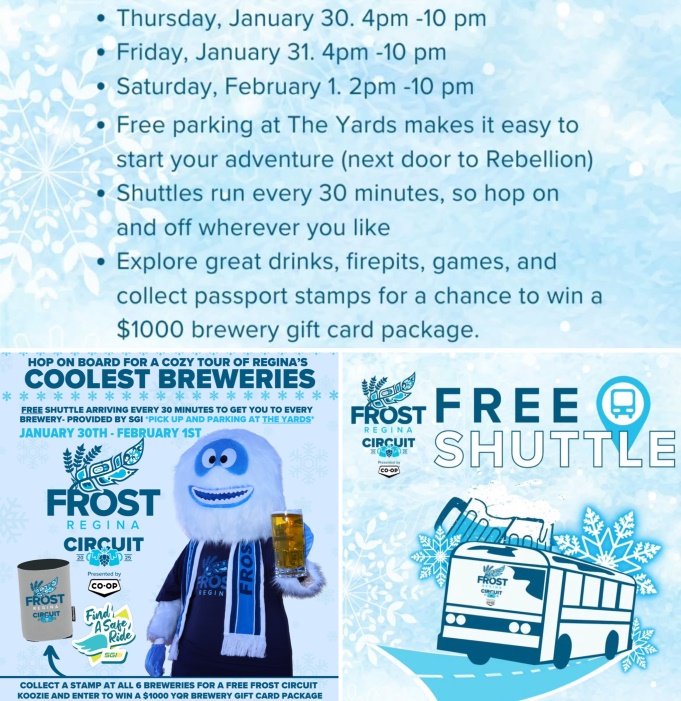
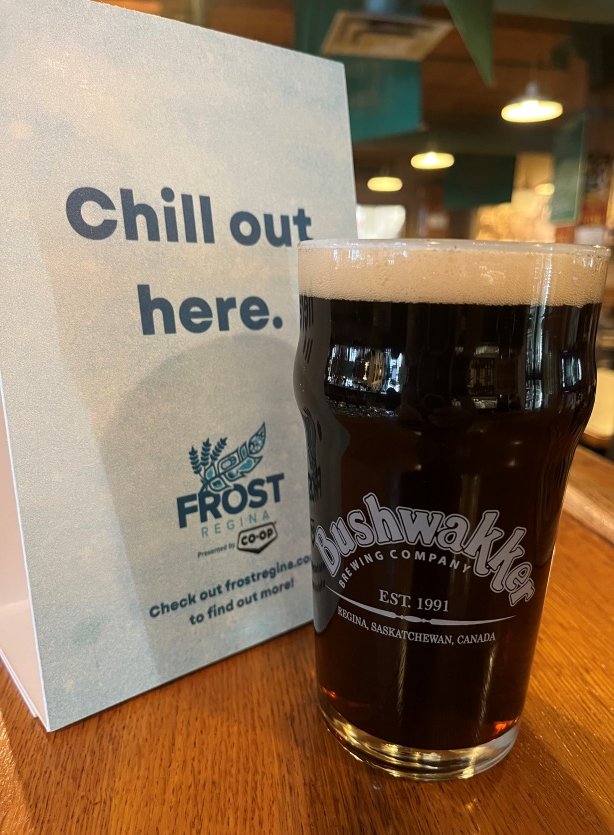
The Regina FROST CIRCUIT is this Friday and Saturday! Enjoy free shuttle service between six fine craft breweries, receive a free commemorative beer koozie after visiting all breweries plus enter for a chance to win a $1000 brewery gift card package! Be sure to try our SUPER SNOWPLOW commemorative Frost Circuit Ale. A powerful blend of English Barleywine and scotch-infused porter. ‘Tis one bold, frost-busting brew!
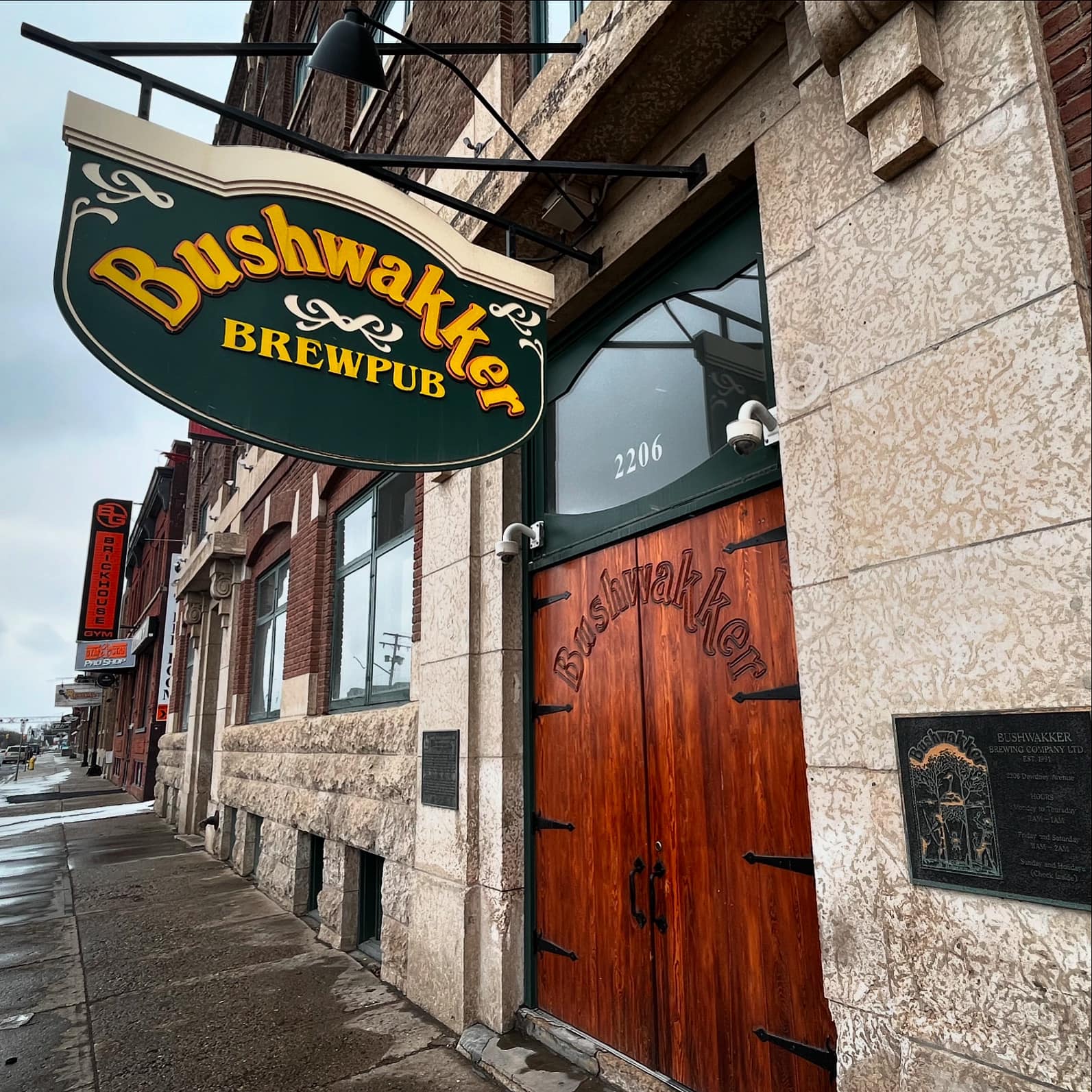
Much thanks to Global News Regina for being proactive and addressing the concerns associated with the upcoming street construction.
https://globalnews.ca/video/10982509/dewdney-avenue-businesses-prepare-for-a-slow-summer
We are very much in support of the Dewdney Avenue Revitalization Project and appreciate the considerable investment which is being made right outside our front door. When completed, this beautification effort will be a boon for local tourism and many businesses will benefit. Improving the Dewdney strip is also a key initial step in kick starting development in the railyards area right across the street. The challenge is surviving yet another long construction season where access to the area businesses will be negatively impacted. There must be some creative things that can be done to make the area appear more welcoming and accessible during year two of construction without spending even more money on the project when times are tight. We have a few ideas and hope to discuss them with the city very soon. Any positive suggestions you have regarding the mitigation of this challenge are certainly welcomed and appreciated!
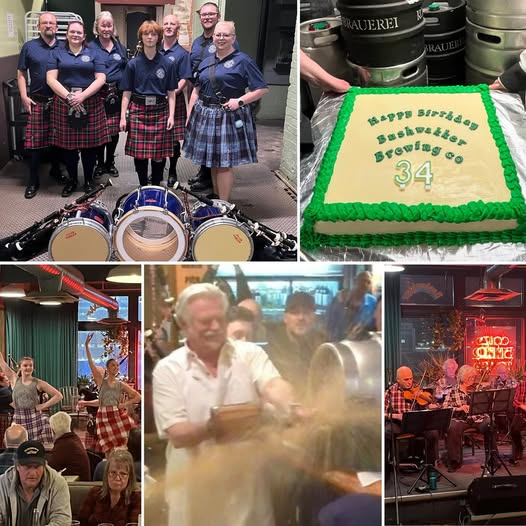
Last weekend’s Bushwakker Robbie Burns Birthday Bash was a huge success! A great evening of Scottish dance, music, food and drink was had by all. The firkin of Double Scotch Ale was emptied quick and the haggis and neeps received much acclaim. Thanks for 34 years of enthusiastic support. Can’t wait to do it again next year!
We had hundreds of customers take part in our 34th Bushwakker Birthday Trivia Quiz last week. The winner of the $100 Bushwakker gift card was Marilyn Knuttila. Bar manager, Grant, always loves it when we select a winner who claims they have never won anything before in their entire life. Congrats Marilyn!
UPCOMING EVENTS
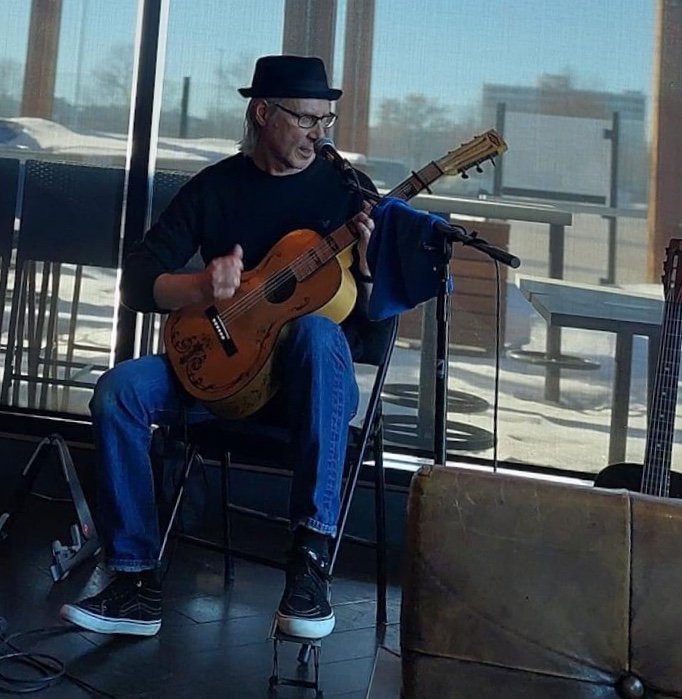
Feb. 3: Monday Night Jazz & Blues. COLIN WIEST. Acoustic, resonator and electric blues guitar veteran. Enjoy 1920’s Mississippi delta to 1960’s Chicago blues. 7:30 PM – 9:00 PM.
Jan. 8: MONTHLY ALES CLUB MEETING. If you are interested in delving into the world of homebrewing or are just looking to brush up on your brewing skills then the ALES Club is for you! The February presentation topics include SOURS as well as the EASY CUP MALT EXTRACT BEER COMPETITION! Come to the Bushwakker basement clubroom at 7:00 PM and discover what the ALES Club can offer you. New members are always welcome!
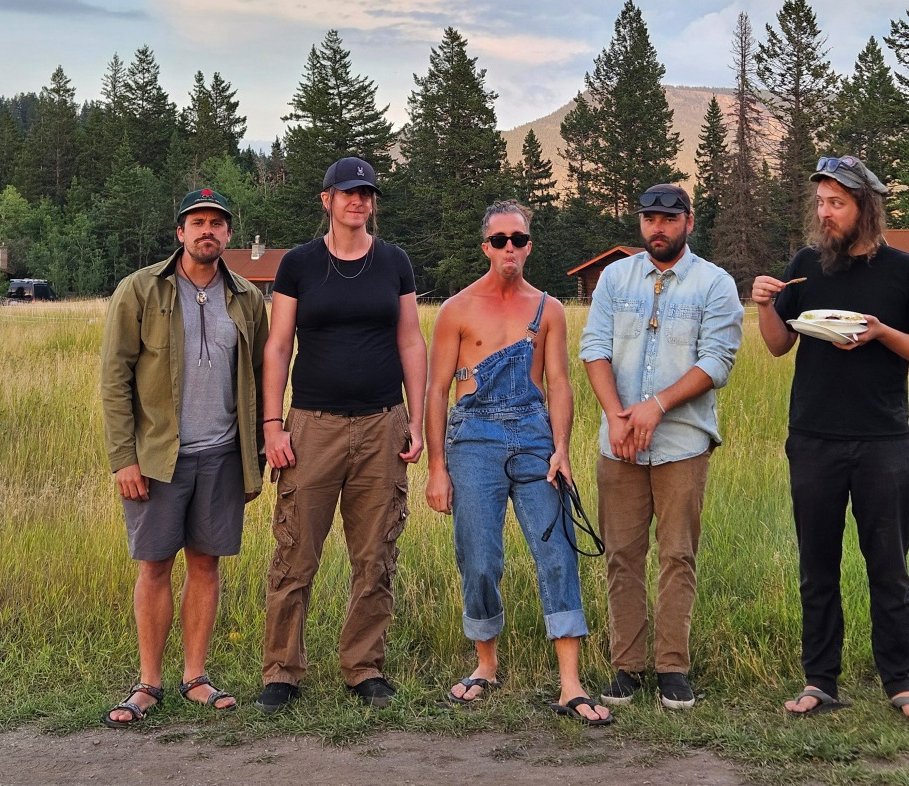
Feb. 5: Wednesday Folk Night. THE SOUR PATCH MEN. Calgary based energetic indie folk bluegrass band makes their Bushwakker debut! Get ready for a wild ride! 7:30 PM – 9:00 PM.

Feb. 6: SCIENCE PUB – CHATGPT: BRILLIANTLY CLEVER, RIDICULOUSLY CLUELESS. Our wildly popular Science Pub Series returns for a 12th incredible season! Enjoy lectures on scientific topics of general interest in our Arizona Room over fine craft beer and award-winning pub cuisine. The room opens at 5:00 PM. Avoid disappointment and come down early for dinner and a pint before the presentation which begins at 7:00 PM.
This month’s lecture is an early one and will be presented by Dr. Affan Shoukat, SGI assistant professor, department of mathematics and statistics at the University of Regina. Dr. Shoukat will present historical journey that got us to ChatGPT today, how it works (but avoiding all technical math), and then a brief discussion on the challenges of AI on human society, where it’s headed, how it can help us but how it can also be of danger.
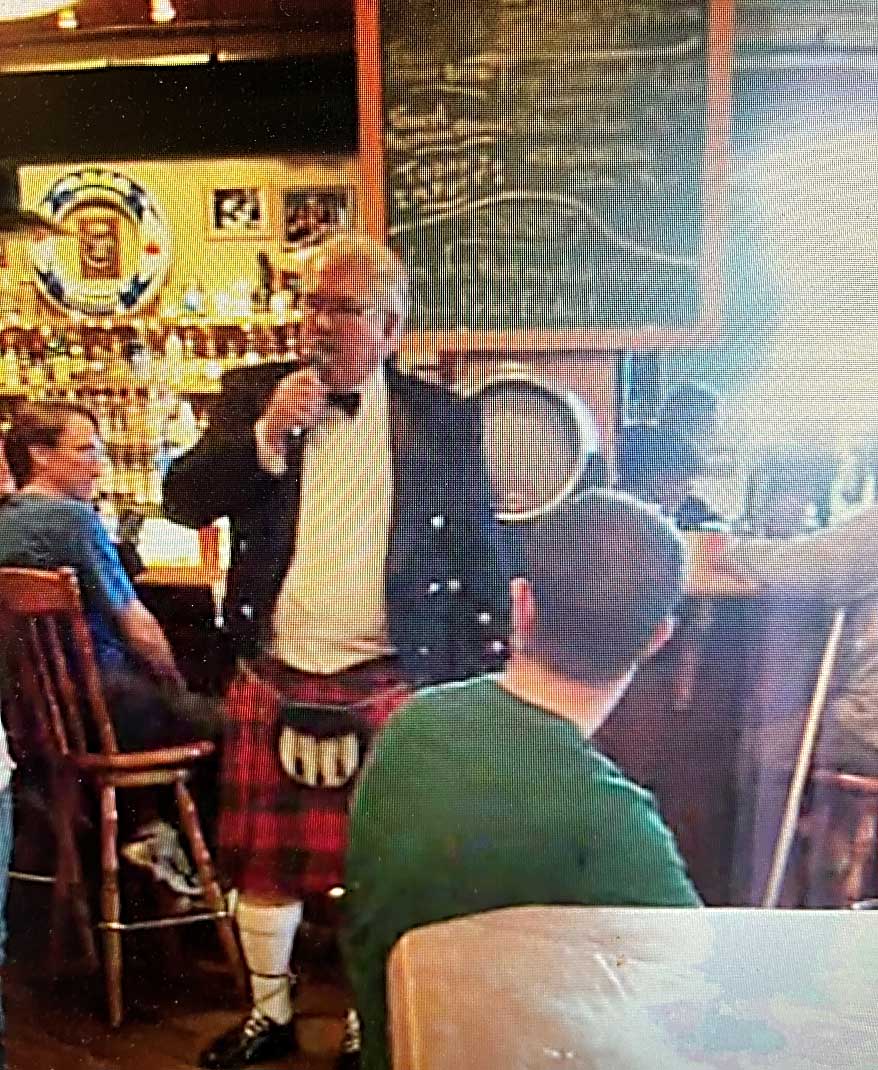
Feb. 7: FIRST FIRKIN FRIDAY. A special firkin tapping to kick off our Tribute Weekend to late Bushwakker co-founder and president, Bev Robertson! A piper from The Regina Police Services Pipes & Drums leads a keg (the firkin) of special ale throughout the pub in a procession. A guest volunteer tapper is selected to wield the handmade wooden maul affectionately named, The Mighty Firkin Wakker, and attempts to tap the keg in one mighty blow! This month’s Bev Weekend Tribute firkin offering will be a VANILLA PORTER in celebration of his love for Apple Betty with vanilla ice cream and his national award-winning Palliser Porter – the beer that launched The Bushwakker! The suds-soaking spectacular takes place at 5:30 PM.
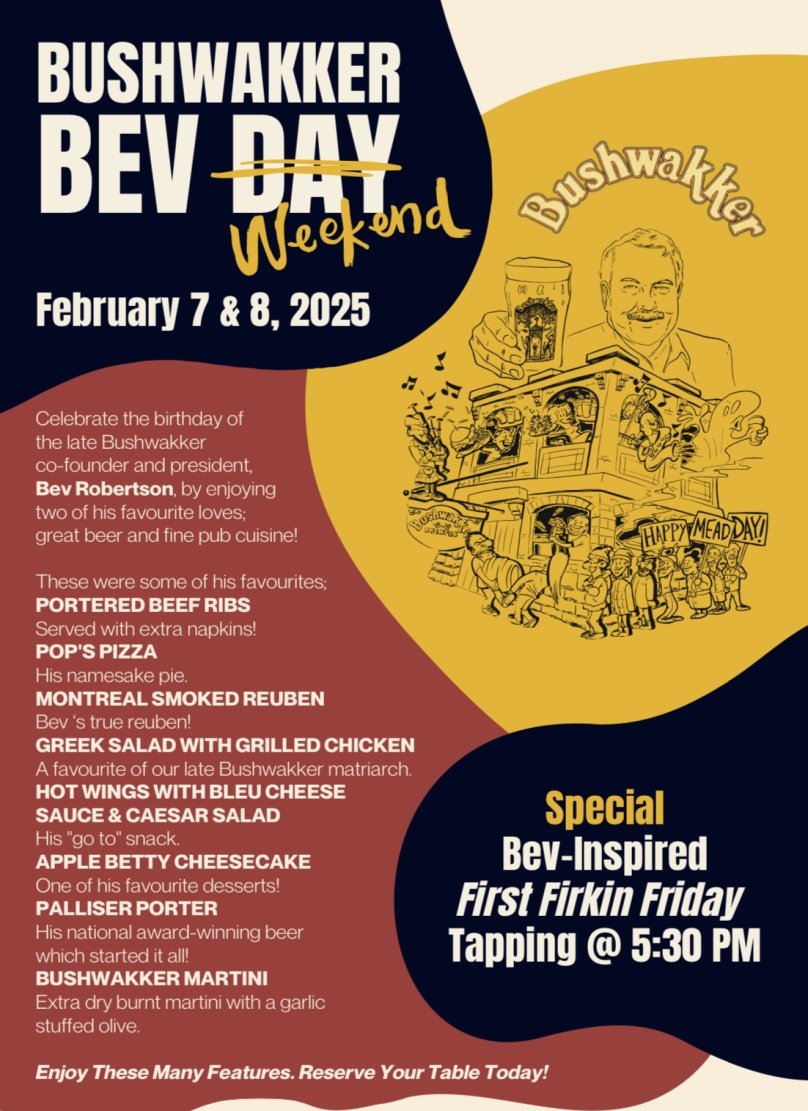
Feb. 7 – 8: BUSHWAKKER BEV DAY WEEKEND. Celebrate the birthday of the late Bushwakker co-founder and president, Bev Robertson, by enjoying two of his favourite loves; great beer and fine pub cuisine! These will be some of his featured favourites; Portered Beef Ribs, Pop’s Pizza, Montreal Smoked Reuben, Greek Salad with Grilled Chicken, Hot Wings with Bleu Cheese Sauce & Caesar Salad, Apple Betty Cheesecake, Palliser Porter and Bushwakker Extra Dry Burnt Martinis with a garlic stuffed jumbo olive. We’ll kick off the weekend with a special “Bev-inspired” edition of First Firkin Friday at 5:30 PM!
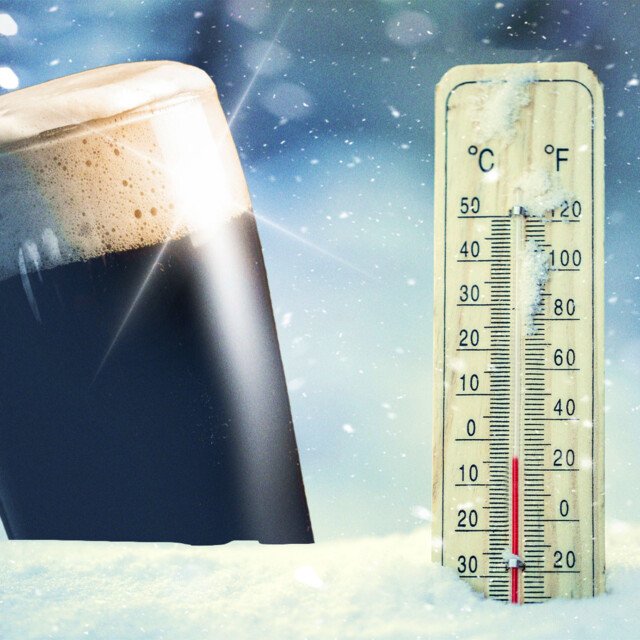
The Cult of Eisbock (and Why Most American Breweries Will Never Be Able to Make It)
If you were a somewhat rebellious teenager and happened to replace some of your parents’ vodka with water from time to time, you may have discovered that alcohol and water freeze at different temperatures. Alternatively, if you were a late-19th-century German brewmaster, you might have observed this phenomenon and seen opportunity. Enter the eisbock, the big, bold, booze-adjacent beer that is almost unheard of in American breweries.
What is an Eisbock?
Simply put, an eisbock (pronounced ice-bock, which is its literal translation) is a doppelbock that has been freeze-distilled. To make it, the already strong, sweet, and malty German lager is chilled to subfreezing temperatures, at which point ice crystals begin to form in the beer. The ice crystals are then strained out, leaving behind a product that’s the opposite of watered down.
In and of themselves, freeze-distilled beers are not all that uncommon. It’s where the “ice” in Icehouse, Bud Ice, and Natty Ice comes from. The important distinction here is which kind of beer is being frozen and the amount of ice removed. The aforementioned beers begin with a light lager, and are iced up to a strength of about 5.5 to 6 percent ABV. But what if the base beer was stronger (hello, doppelbock) and further concentrated by the removal of much more ice? These are the makings of an eisbock.
What does an eisbock taste like? Well, like a doppelbock, but… more. A doppelbock is a strong, malty, and sweet German lager that usually ranges from 6.5 to 9 percent ABV. A decadent spin on regular bocks, the doppelbock is a much older style compared to the eisbock, and can be traced back to the late 18th century. While these beers are often referred to as “liquid bread,” that nickname undersells the sweet notes of toffee and hints of dried fruit present in a good doppelbock. Popular examples of the style include Pauliner Salvator and Ayinger Celebrator.
00:15
So, when a doppelbock is freeze-distilled into an eisbock, what’s left behind is an amplified version of it. The malt sweetness is more concentrated without becoming cloying. The notes of dark fruit burst forward with a port-like intensity. The toffee-raisin aroma is even more pronounced. Most astoundingly, despite the substantially higher alcohol content, the extra concentration of ethanol can be barely perceptible.
The history of Eisbocks
The origins of the eisbock style vary depending on which beer bottle you’re reading the back label of. The most romanticized version of the story involves a negligent brewer’s apprentice leaving a barrel of doppelbock outside on the night of a deep freeze. The next day, assuming the beer was ruined, the furious brewmaster made the apprentice drink from the frozen barrel as punishment. To their surprise, the apprentice was delighted by the result of his happy accident. An alternative version of the myth involves a doppelbock freezing during transportation with similar effects.
Details aside, we do know for sure that the eisbock as we now know it can be traced back to Franconia in the late 19th century. Kulmbacher Brewery is widely regarded as the first to produce it commercially, and still sell it today as Kulmbacher Eisbock. While still relatively uncommon, a number of German breweries have since developed a take on the style. However, in the U.S., hardly any have been produced.
Why are Eisbocks rare in the U.S.?
Usually, the scarcity of a given style comes down to it being overlooked in favor of hazy IPAs, fruited sours, and candy-laden stouts. While that may play a part of it, there’s another complicating factor preventing American breweries from being able to make eisbocks.
The main obstacle that prevents U.S. breweries from producing eisbocks can be found in the name of the method used to create them: freeze-distillation. While eisbocks fall well short of the proof of most spirits, the freeze-distillation method is still considered a form of distillation by the Alcohol and Tobacco Tax and Trade Bureau (TTB). As a result, any brewery that wants to freeze-distill its beer must also have a distilling license. Even for the small number of American breweries that meet this criteria, they’d also need a freezer capable of bringing the temperature of an entire batch well below 30 degrees Fahrenheit for a sustained period of time.
The only American brewery that appears to release an eisbock annually would be Kuhnhenn Brewing Company out of Warren, Mich.
Even home brewing an eisbock is considered illegal, as the TTB states only up to 0.5 percent of a beer’s volume can be removed via freeze-distilling to boost alcohol content, whereas a proper eisbock should have 20 percent or as much as 40 percent of its total water volume filtered out.
Breweries outside the U.S. have managed to push the freeze-distillation method to the extreme. For instance, in 2020, BrewDog and Schorschbrau collaborated to create the 57.8 percent-ABV Strength in Numbers. To reach that concentration, they utilized medical-grade freezers, and the beer was packaged in 40-milliliter bottles. Although “Eisbock” was on the label, that’s a bit of a misnomer, as a higher-ABV Belgian strong golden ale was used as the base beer.
Where can you find Eisbocks?
While the production of eisbocks is regulated as though they’re a spirit, they’re fortunately treated like any other beer when it comes to imports, distribution, and sales. As a result, most available eisbocks tend to be imported from Germany and other European nations, though some American breweries have ventured to give the style a try. As mentioned earlier, the first eisbock produced was the 9.2-percent ABV Kulmbacher Eisbock. Though rare, it can be found in the U.S., both in bottles and occasionally on draft. However, the most readily available eisbock would be Schneider Weisse’s 12-percent ABV Aventinus Eisbock. In addition to being more widely available (though still uncommon), Schneider Weisse’s take on the style also provides the unique opportunity to do a side-by-side taste test with its non-frozen equivalent, Aventinus.
When it comes to American-brewed eisbocks, all we can say is good luck finding them. A select few breweries also carry distilling licenses, allowing them to legally freeze-distill their beers, but the end result is usually a small-batch taproom exclusive, and they’re historically brewed as one-offs. The only American brewery that appears to release an eisbock annually would be Kuhnhenn Brewing Company out of Warren, Mich. Not only does it release an eisbock, but raspberry and blackberry iterations as well. A few larger breweries have taken a stab at them in years past, such as Heavy Seas’ 2018 release Schnee Boot, a bourbon-barrel-aged take on the style. The good news is that because of their high ABV and rich maltiness, even a vintage bottle of eisbock will still be packed with flavor.
If you’re lucky, maybe your local brewery will hire a negligent apprentice next winter. Otherwise, all you can do is keep an eye out. In the meantime, we suggest seeking out other bold German styles instead. They’ll rarely let you down, and you may end up stumbling across a true eisbock.
TIME OUT – Frost Festival Inspired Humour
What did the snowman say after losing its arm? I’m never playing fetch again!
Why did Dad stop using his loyalty card to scrape ice from his windshield? He only got 10% off.
What do you call a snowman with abs? An abdominal snowman.
What do mountains wear to stay warm? Snowcaps.
How does a snowman get to work? By icicle.
What did the wool hat say to the scarf? You hang around while I go on ahead.
What did the police officer say when he saw the snowman stealing? Freeze!
No need to battle to elements during this weekend’s FROST CIRCUIT. Enjoy free shuttle bus service between all six participating Regina craft breweries!